vd8j9ro3p6
Category: languages
I am periodically stunned by the insipidity of much of the Star Wars “Expanded Universe”, and the way that incidental references are inflated through mechanical cross-referencing into something of tediously world-shattering importance. For example: did you know that IG-88 (a bounty hunter ‘droid seen en passant on the Death Star in The Empire Strikes Back) was actually one of four assassin droids in its series, and these four planned a “‘droid revolution” that would annihilate all biological lifeforms? And that one of these ‘droids uploaded its consciousness into the second Death Star, and was destroyed just before it could take over ALL THE ‘DROIDS IN THE GALAXY?!
 Ay gevalt.
I thought I’d grown calluses over the part of my brain that could be harmed by further violence to the Star Wars saga, but I am newly aghast at this article on the Jawa language. Here’s how you count in Jawaese:
- 1 Po
- 2 Ko
- 3 Kyo
- 4 Yo
- 5 Dyo
- 6 Lyo
- 7 Does not exist in Jawa arithmetic
- 8 Ho
- 9 To
We’ll skip past the lameness of having a merchant race use words for numbers that can barely be distinguished when spoken. The number seven doesn’t exist? This sort of “novelty” is the work of an inane intellect.
(The best extension to the Star Wars universe, I think, was the early trio of Han Solo books by Brian Daley. These didn’t reference anything in the original trilogy except for Han and Chewie, reinforcing the immensity of the setting rather than turning it into something claustrophobic and inbred. Also, I prefer to regard episodes 1-3 as regrettable fanfic.)
Since my original post on the topic, I’ve tried many methods to learn to produce a rolled ‘r’. After quite a bit of practice, I managed to come up with an alveolar flap that sounds more-or-less like it should, but a sustained trill remained elusive…until now.
Commenter falco (whose comment, I admit shamefacedly, was missed and has languished in the approval queue since January) writes of his early troubles (and recent success) learning the trill:
I am 32 now, my mother tongue has the alveolar trill; however, I was the only one of the family and the class (in the past) that couldn’t produce it; so around the age of 6, they forced me to learn the uvular trill by gargling water, as it was believed in those times that all sounds must be learnt before the age of 7 or it would be to late. So, I spoke my own mother tongue wit a uvular trill, which always made certain people think I was originally from somewhere else, an immigrant in my own country (first frustration).
[…]
It is an article on the internet that I found a little time ago that changed everything: http://www.wikihow.com/Roll-Your-%22R%22s
In days, I learnt to roll my ‘r’ by using the “Tiger Method”. I also used the site http://www.uiowa.edu/~acadtech/phonetics/spanish/frameset.html under “vibrantes” and then [r] to see the different steps of the sound-reproduction. As none of the above techniques in this website had worked for me in the past; apparently the tiger method was the only one that did it for me starting from a uvular trill.
What is the tiger method? I was initially skeptical, as other initally-promising methods that I’d tried had met with only indifferent success. wikiHow (whose Creative Commons attribution clause states that I need to write that this excerpt comes from “wikiHow.com – The How-To Manual That Anyone Can Write or Edit”) describes it as follows:
The key to rolling R’s is creating the proper vibration. The vibration starts at the back of the tongue and moves toward the tip of the tongue (like a wave). If you can produce the German “acht” or Arabic and Yiddish pharyngeals and basically clear your throat, then you can roll R’s. This seems counter-intuitive because rolled R’s are pleasing to the ear – whereas pharyngeals are harsh. The vibration is the key and the same technique is needed to roll R’s. Remember: The air passing through your larynx and mouth makes the sound.
- Start by practicing that clear-your-throat “ckh” sound. Try to turn it into a “grr”. Don’t be afraid of sounding ridiculous. Do whatever it takes to make the roof of your mouth vibrate. (This skill also comes in handy when speaking Chewbacca and making a variety of animal noises.) Practice getting the feel for that vibration. Your throat might get a little sore at first. You’re working out “new” muscles and they’ll get stronger with use.
- Press the tip of your tongue against the alveolar ridge behind your teeth. Your tongue touches the right spot when you finish saying the letter L and the letter N. Say L or N and at the end of the sound keep your tongue firmly in place. Try to say “girl” and “hurl” without removing the tip of your tongue from your alveolar ridge. Use the clear-your-throat vibration to start the word and try to form the vibration into a rolled R. Initially, use the “G” sound to kickstart a rolled R. At first, you will sound like a strangled tiger (grr, grr, grr), but you’lI start rolling R’s. Eventually you will be able to purrr using purrrfectly rrrrrolled Rrrrrrrrrrrrrr’s.
- Practice and refine. Once you can get your R rolling, experiment with the position of the tip of your tongue. To move the sound toward the front of your mouth, add the “Z” sound in front of your R. Practice adding vowel sounds (ah, ee, uh, o, oo) before and after the rolled R’s.
My instant results were astonishing. At first, it sound much like someone trying to strangle a pig. (This method is not for the self-conscious!) Almost immediately, though, my tongue started vibrating with the airflow. Within five minutes I managed something that sounded (and seemed to feel) like an actual alveolar trill.
This method is a little hard on the throat, and after ten minutes I was starting to feel a bit light-headed. I will be continuing to practice over the next week, and will report on how it goes. At the moment, once I achieve the trill I can sustain it indefinitely, but there is much hunting around before tongue and airflow find the right position and balance of tension. If I attempt to transition into a word, it falls apart.
falco concludes his comments:
I’m now practicing to soften the trill a little more and use it in different words of different difficulty levels… but I am confident that it’s just a matter of time now before I can speak fluently with a rolling r, the alveolar trill!
Record your voice on a computer/mobile and listen to yourself in order to easily define errors or its evolution, compare it to the recorded r-sounds on the above-given website (www.uiowa.edu)… and most importantly: DON’T GIVE UP, you might sound ridiculous at the beginning but we can all learn it!
Intelligent bloody-mindedness is the key. If you’ve been trying to learn to roll your ‘r’s, I strongly recommend giving the tiger method a try. If anyone has successes (or failures) using this method, I’d love to hear about them.
I’ve been playing at translating a bit of Petronius, which is great fun—when I saw that a LatinStudy Satyricon group was starting up, I couldn’t resist. Perhaps it is somewhat beyond my nascent Latin skills, but it’s a nice change from the Vulgate. I’ve been taking a fairly loose approach, a bit looser than I’d think acceptable for a translation I was reading.
The opening fragment begins with a superb rant. Here’s a bit from my rendering of paragraph II:
Great oratory is, if I may say it, modest. It is not this swollen, disreputable blather; rather, it flows beautifully and naturally. Your flatulent spew of words is a recent migrant to Athens from Asia, a pestiferous, ill-starred exhalation upon the growing minds of our young men. Once established, it rotted our standards of eloquence, rendering us dumb.
Since then, who has risen to the level of a Thucydides or a Hyperides?
Poetry herself glistens with an unhealthy pallor. All the arts, in fact, have been weakened by a diet of this tripe, sapped of their chance to whiten into old age. Even painting has fared no better since those Egyptian poseurs discovered how to ruin that great art with their slapdashery.
There’s something reassuring about millennia-old vituperation.
(The title of this post, incidentally, comes from a line in paragraph I: “. . . sed mellitos verborum globulos, et omnia dicta factaque quasi papavere et sesamo sparsa.)
Since my first junior-high Spanish classes I have been rankled by my inability to produce a proper rolled ‘R’. Since I began studying Latin at the beginning of the year, my need to triumph over this handicap has become pressing. I’m sure I sound like some sort of Germani barbarian.
Too many interesting languages require the ability to produce a trilled ‘R’: Latin, Russian, Italian, Arabic, Spanish. I am unwilling to accept this as a permanent handicap. Anyone riding in the car with me on my daily commute would be treated to a wide variety of peculiar noises, a few of which are beginning to approach the proper sound.
My goal is nothing less than mastery of the dreaded voiced apical-alveolar trill. I’ve always been able to produce an uvular trill (which was good enough for Vladimir Ilyich), and I can produce the Japanese lateralized rhotic without problems. After many years, I knew that simply hearing more properly-trilled ‘R’s was not going to solve my problem, but I hadn’t been able to find any detailed descriptions of the anatomical details of its production or useful suggestions for achieving it. “Make a noise like a car engine” and “Purr like are cat” are distinctly useless as they send me straight to my uvula.
When I found out that M—— can produce a trilled ‘R’, I drilled her closely about what exactly happens when she produces it, where exactly her tongue contacts her palate. This was a start, but not enough.

The University of Iowa has an anatomical animation of a rolled ‘R’ in action (click on Modo -> Vibrantes -> [r]), and even after watching it over and over and over I still can’t relax enough to let my tongue vibrate passively with the airstream; my trill is conscious, slow, and somewhat clumsy.
Much digging on the Internet has resulting in a wealth of advice, some of which is actually useful. Here are some brief excerpts capturing the more helpful tidbits; refer to the links for the full articles:
From LINGUIST List:
- A trick I use with my students (mostly native English speaking undergrads.) for teaching them how to feel the position of the tongue is to say “I edited it” really fast.
- you have to train the muscles in the mouth which would be developed as a matter of course in speakers of languages where the [r] occurs “naturally”. You do this by repeating the phonemes [t] and [d] (with some kind of neutral schwa sound in between) as fast as you can, for say five minutes a day.
- Don’t know if this works but try to put your tongue where you would for English /l/ and think /tr/, then get rid of it later on.
From Tenser, said the Tensor (quoting Jones and Ward, The Phonetics of Russian):
- Some English people are able to acquire a rolled r by the following method. Pronounce slowly the exercise tədɑːtədɑːtədɑː… preferably with dental t’s and alveolar d’s; then gradually increase the speed. When said very fast indeed, the alveolar d has a tendency to turn into a ‘flapped’ or ‘semi-rolled’ r-sound, i.e. a sound formed after the manner of rolled r but consisting of only one single tap of the tongue (see § 22.4 above). With r representing here the flapped r, the resulting sequence sould be written tərɑːtərɑːtərɑː… or trɑːtrɑːtrɑː… (according to the rate of saying it). It then remains to isolate this r and extend it into the fully rolled sound.
- [From a comment to the article] First try to produce dental plosives ‘t’ and ‘d’ (Remember that ‘t’ and ‘d’ in English are alveolar plosives). Then with the dental plosives try to make syllables like ‘tra’, ‘dra’, ‘tri’, ‘dri’, ‘tru’, ‘dru’ etc. Try to hit the alveolar ridge immediately after articulating the ‘t’ or ‘d’ sound. (Remember that if you use the alveolar ‘t’ or ‘d’ sounds in these syllables, you can’t articulate the following ‘r’ as a tap.) When you can articulate a tap in these syllables, try to articulate a tapped ‘r’ in syllables like ‘ra’, ‘ri’ etc. When you are comfortable with that, you can go and try for a ‘trill’. For the trill, first try it in isolation, and then use them in syllables.
From Babel Babble:
- You put your tongue in a [d], [n], [l] or [t] position. Make the uppermost one or two centimeters of your tongue (but not the actual tip) touch the gum (well, that part up in your mouth where you pronounce most of [d], [n], [l] and [t]). Now you’re ready for the difficult bit. Push some air out strongly so that it flows over your tongue. But don’t leave your tongue static. Use the air to make the tongue vibrate quickly, like an annoying alarm clock: rrrrrrrrrrrrrrrrrrrrrrrin.
- […] mothers put a spoon on their childrens’ tongues and get them to pronounce a “d” in order to train them to pronounce “r.”
- I think the tricky bit is to feel how strongly you have to push the tongue against the alveolar region, if you press too strong or not strong enough, your tongue won’t make the right sound.
From WikiHow:
- Curl your tongue up very slightly just behind your top gums. Specifically the tip of your tongue should be loose and just below the roof of the mouth between the upper teeth and the hard palate: the alveolar ridge. The part of your mouth that contains the tooth sockets is the right place to be.
- Depending on the specific language your tongue may be slightly touching your alveolar ridge, or not touching.
- Tense your tongue, but leave the tip loose to vibrate. This sound is known as a trill because it is created with multiple vibrations.
- Breathe out, allowing your tongue to vibrate with the passing air.
- The sound is made because of the Bernoulli’s principle, an aspect of physics which defines the movement of fluids and gas over different shapes, and one of the principles of flight. In other words, the shape of your tongue will partially resemble an airplane wing, with the exhaled air passing over the top of the stiff, shaped lower tongue and vibrating the tip against the ridge like the flaps on an airplane wing.
Has anyone out there managed to learn how to produce an alveolar trill as an adult? I’d be very interested to hear tips or stories.
Categories
A Latin Miscellany
My time for reflection is slight, so here are a few Latin tidbits that I’ve been saving up:
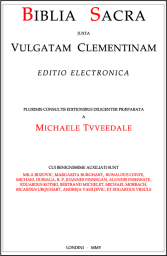 I had an interesting email exchange with Conrad on approaches toward learning Latin. He recommended tacking real texts as quickly as possible, not limiting one’s fare to artificial textbook examples. His further recommendation was to start with the Vulgate. Not very much digging turned up a nicely printable PDF version of the Clementine Vulgate at SourceForge, of all places. (Sadly, only the title page is set in red and black.) Liber Genesis is printed out and waiting for quals to be over. “In principio creavit Deus caelum et terram“—this looks quite approachable.
- In the previous bullet, I linked to a Wikipedia article. I probably should have linked to Vicipedia, the Latin-language edition, which has more than 10,000 user-contributed articles. (Here’s the Vicipedia article on the Biblia Vulgata.)
- If you want a dose of spoken Latin, try Nuntii Latini, a weekly (very short) broadcast of world news from YLE Radio Finland. It’s available as a podcast, so no need to fire up your shortwave. I admit to finding it a bit peculiar to hear Latin with a strong Finnish accent, but as we all know, the Empire never ended—it’s hardly surprising that we barbarians speak with the shadings of our original tongues.
Here endeth the link-post. Further updates as time permits.
 A major story on today’s NPR Morning Edition was the fiftieth birthday of The Cat in the Hat. Personally, I’ve never been much of a fan of Dr. Seuss. (When I was that age, I much preferred Mike Mulligan and His Steamshovel.) Still the mention of Cat reminded me of a Dr. Seuss I can really get behind: Cattus Petasatus, a translation of the original book into Latin by Jennifer and Terence Tunberg.
Some alterations to the meter were required, but the spirit remains intact:
Imber totum diem fluit
Urceatim semper pluit.
Taedet intus nos manere:
Numquam potest sol splendere.
The result is disconcertingly similar to authentic medieval Latin verse.
Primo pro nummata vini;
ex hac bibunt libertini;
semel bibunt pro captivis,
post haec bibunt ter pro vivis,
Thoughtfully, the publishers provide a guide for using Cattus to teach grammar.
This is certainly not the only children’s classic that has been translated into the language of Virgil. The Tunbergs have also tackled two other Seuss volumes: Virent Ova! Virent Perna! and the euphoniously-named Quomodo Invidiosulus nomine GRINCHUS Christi natalem Abrogaverit.
Moving beyond the basic readers, we have one of my favorites: Winnie ille Pu.
Ecce Eduardus Ursus scalis nunc tump-tump-tump occipite gradus pulsante post Christophorum Robinum descendens. Est quod sciat unus et solus modus gradibus descendendi, nonnunquam autem sentit, etiam alterum modum exstare, dummodo pulsationibus desinere et de eo modo meditari possit. Deinde censet alios modos non esse. En, nunc ipse in imo est, vobis ostentari paratus. Winnie ille Pu.
I recently happened across a mention of Aliciae per speculum transitus (quaeque ibi invenit). Sadly it looks like it’s been out of print for many years, along with its predecessor, Alicia in terra mirabili. Happily, the text of this latter is available online.
Itaque cogitabat (nempe ut lucidissime poterat, nam tempestate calida torpebat semisomna) num operae pretium esset surgere et flosculos carpere, modo ut sertum nectendo se delectaret, cum subito Cuniculus Albus oculis rubris prope eam praeteriit. Neque in eo erat quidquam magnopere dignum memoria: neque Aliciae valde insolitum videbatur ut Cuniculum sibi loquentem audivit: ‘Vae, vae! Sero perveniam!’
And you still want more? If you’re one of those people who actually likes the loathsome original, you might try Regulus. Do you prefer Beatrix Potter? Then Fabula de Petro Cuniculo would be more to your tastes. A final pair to mention (by Andrew Needham, who also translated Ursus nomine Paddington) is Harrius Potter et Philosophi Lapis and Harrius Potter et Camera Secretorum. No samples from these, I’m afraid . . . they’re both on the to-purchase list. Still, see the Times review of Camera . . . in Latin, no less.