A Modicum of Order

After a moderately hellish Anno Domini 2008, the solstitial vacation was quite welcome.  Rooms were frantically cleaned, relatives descended, food was devoured, and tasty, tasty beer from my birth state was consumed.  At last, the wreckage cleared, I found myself at ends for a few days.

When M—— and I moved to our current house, five years ago or so, the books were not neatly organized.  No, indeed, the first boxes were unloaded without ceremony onto the nearest shelf until all were full,  leaving several dozen which had to be piled into the attic where they yet remain.  A few ordered clusters emerged (philosophy, for example, moved over nearly intact), but others (oy, the Judaica!) seemed to be equally distributed over the entire house.

Desorted Bookshelf

This Saturday, I settled in for the pleasant task of finally sorting through some of the morass, which mostly meant making piles of books on every available horizontal surface (and several wobbly fabric surfaces).  The picture at right shows the dining room table after the first of the shelves had been emptied.  I played Maxwell’s demon, attempting to shuttle like volumes toward their kindred.  But where does one file Thurber’s Fables for Our Time?  Does Manzanar get placed with Holocaust, with the World War II books, or with twentieth-century American history?  (I settled on the last of these for Manzanar, but the Thurber is still a puzzle.)

It will be a long time until the Kindle or its ilk replace the physical volume.  Sure, it’s easier to keep dusted, but the experience of renaming a directory of e-book files is nothing like the tactile pleasure of handling a stack of real tomes.

Maybe its my limited budget, but I’ve never gone in much for collecting volumes of serious bibliophilic interest.  A nice trade paperback can be extremely satisfying, and one doesn’t need to worry about maintaining it in humidity-controlled isolation…content trumps all.

Faced Shelves

Rooting around in one shelf, I made some gleeful rediscoveries: a copy of an Ionesco children’s book (Story Number One), chapbooks of Michael Swanwick short-shorts (Puck Aleshire’s Abecedary and Field Guide to the Mesozoic Megafauna), my hardcover of the Annotated Snark, four volumes that had been originally filed together because of their Gorey cover illustrations.  The real frisson, though, comes from the order itself, looking at the neatly-faced shelves and recalling every book and the reason it was placed with its fellows.

As midnight neared, I realized the task was not to be completed in a weekend.  Laggard books were hustled back willy-nilly and surfaces cleared, but somehow, they had expanded.  All the shelves are full, but many book-feet remain.  The guest room is encrusted with piles and, somehow, a waist-high stack stands in front of the full case in M——’s sewing room.  Work begins again tomorrow, class on Tuesday, and my evenings will again be spent on my Ph.D. studies.  In spare moments, though, I can refile a book here, a book there, perhaps bring a box down from the attic.  The seed crystal of order has been planted, and the lattice of the library will form inevitably around it.

Chariots of the Muses

Consider, for a moment, alternate history.

We’re speaking here not of a particular history, but of the genre, the speculative fictions that ask: What if things had been different?

There are many variations on this theme. Perhaps an important event has a different outcome (Persia crushes the upstart poleis of Greece, wiping democracy from the historical stage), or a strange development changes everything (Jean-Marie Jacquard follows up the principles suggested by his earlier invention and creates a general-purpose Ciphering Loom, ushering in a Napoleonic ère de l’information). Quite often, the change selected for the story is a small one, and the interest is in working out the complex ways that things might change further down the time-stream. (For encyclopedic, alternately-historical fun, check out Uchronia or the bite-sized glimpses into nearby universes dished out at Today in Alternate History).

Perhaps these phantasies are more science fiction than one might think at first: in the July 2 issue of Nature, Peter Turchin writes (behind a paywall, unfortunately):

…[W]e need a historical social science, because processes that operate over long timescales can affect the health of societies. It is time for history to become an analytical, and even a predictive, science…Rather than trying to reform the historical profession, perhaps we need an entirely new discipline: theoretical historical social science. We could call this ‘cliodynamics’, from Clio, the muse of history, and dynamics, the study of temporally varying processes and the search for causal mechanisms

Shades of Asimov’s psychohistory!

Ken Hite, in his Suppressed Transmission column, often writes of Clio and alternate histories. (In fact, I suspect that a search of his essays might turn up a prior coining of the term ‘cliodynamics’.) In “An Alternate-Historical Alphabet”, he propounds the following theory:

All Change Points (q.v.) from Xerxes (q.v.) to the last presidential election, create worlds with clean, efficient Zeppelin traffic. Changing history may produce Zeppelins as an inevitable by-product, much as bombarding uranium produces gamma rays. Often, the quickest way to tell if you are in an Alternate History is to look up, rather than at a newspaper or encyclopedia. From this premise, it is not outside the realm of Plausibility (q.v.) that our history between 1900 and 1936 was, in fact, an Alternate History. It would, at least, explain a lot.

With this in mind, how are we to interpret this recent New York Times story?

As the cost of fuel soars and the pressure mounts to reduce carbon dioxide emissions, several schemes for a new generation of airship are being considered by governments and private companies…[B]ecause of new materials and sophisticated means of propulsion, a diverse cast of entrepreneurs is taking another look at the behemoths of the air.

Clearly, these are parlous times, and the cold, hard light of Science reveals a looming Change Point.

Watch the skies!

Arise, Cliodynamics!” article via Complexity Digest

Zeppelin article via Gizmodo.

Image of a Zeppelin-Luftschiff LZ 127 courtesy Schockwellenreiter.

Get it off get it off getitoff!

My workplace is located conveniently close to Valley Forge Park, so I typically head out for a lunchtime hike. I’ve walked the trails for quite a few years and have had a number of Aldo Leopold moments: an immense swarm of ants executing a slave raid against another nest; a daddy long-legs feasting on a still-twitching beetle; two fawns nursing at their mother’s teat.

Pennsylvania is tick country, and after each hike I try to remember to perform the requisite self-examination, making sure nothing has latched onto my pants or socks. I’ve never actually seen a tick while doing this, but I’m a responsible guy and it’s just part of the drill, right?

Today, I was caught in a drenching downpour when I was a good half-mile out in the woods, and I was thoroughly soaked by the time I slogged back to the car. A bit later, sitting in my cubicle, I reach up to rub my forehead, and something falls, something arachnoid that scuttles under my laptop. Yergh. A tick.

Looking underneath the machine does not reveal it, as it had quickly scuppered off somewhere amongst the cables and papers. I’m not particularly squeamish about insects or spiders, but I have to admit to the newly-discovered fact that ticks give me the willies. A careful check of my trousers, legs and arms revealed no further hangers-on. The tick emerges from a pile of papers, so I trap it in a plastic container. It’s a big, perhaps a bit larger than a pencil eraser, so I’m relieved that it’s probably not a Lyme-infested deer tick.

A bit later, I rub my neck and find a lump, something that feels a bit like a mole. In full acarophobe mode, I find a mirror and, yes, around the back quadrant of my neck a large tick has attached itself, nearly out of sight. YERGH. One should never pull out a tick with one’s fingers, so I vibrate in my seat during the fifteen minute drive over to to visit the company infirmary, remaining CALM, because it doesn’t matter that I have a PARASITE embedded in my flesh.

Later, back at my desk, I find there’s something crawling across the lens of my glasses. Taking them off to look more closely, I find a third tick. Thoroughly creeped out, I put it in the plastic container with the first and check myself again. No ticks, but that’s not particularly reassuring by this point.

Now, one thing I’m a bit worried about is my hair. Once I pass my Ph.D. candidacy exam, I expect I’ll be required to join the Luxuriant Flowing Hair Club for Scientists (the club for scientists who have, or believe they have, luxuriant flowing hair). Flowing, perhaps, but could it be a haven for vermin?

In short, yes. Upon returning home, M—— checked my scalp and, sure enough, a fourth tick had embedded itself in my left temple. YERGH! Was the rain knocking them off the trees?

I think it’s time to buy a new hat.

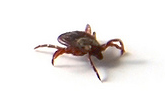
CC-licensed image of a wood tick courtesy of bogdogmax, as I didn’t have my camera and didn’t really feel like keeping my specimens around for purposes of nostalgia.

La gloutonnerie et la bibliothèque

The public library seems to have fallen out of favor, of late. Budgets are slashed. Circulation is down, so the collection must be popularized. Librarians have lost that cultural authority that once let them enforce a stern rule of silence; they even seem grateful for the shenanigans of any Strewwelpeter left to wander around by his piggish parents. What use has the common public library in these days of Internet?

When I moved to Pennsylvania a decade or so ago, I’d fallen out of the habit of libraries. I came from Ann Arbor, an Elysian town of bookstores used and new. Walking the four blocks to downtown, I whiled away many a Saturday strolling from one to the next: West Side, Dawn Treader, David’s . . . there were at least eight within the range of a casual perambulation. Perhaps a drive to Ypsilanti to visit Cross St; a jaunt down to Toledo to Frog Town.

Part of the pleasure was to watch the slow evolution of each inventory, trolling patiently through the shelves wrapped in the scent of old paper. The goal, though, the thrill, was in the kill: a volume of Scholem; a remembered book from childhood (Bellairs, say, with a treasured Gorey frontispiece); a worn paperback of Dick or Zelazny; an issue of Aman’s Maladicta from 1981.

At home, the books piled higher, far exceeding the book-foot capacity of the shelves. I have never sought books as artifacts to be hoarded in alabaster isolation. They are to be kept near at hand, read and handled, annexes to my palace of memory.

When F- entered private school in Pennsylvania, our resources were turned to this new end, and we entered a long period of austerity. Sad as it was, I had to curb my acquisitions.

When one has a personal library, one can survive a year or two of drought. Old volumes are rediscovered. A small cache purchased long ago, boxed and forgotten, emerges from the attic. But after a time, this pales. The soul of the bibliomane craves novelty, the exploration of new semiotic terrain.

It was in this environment of penury and deprivation that I began to rediscover the pleasures of the public library, but slowly. At first, I was dismayed at the plebian assortment. Where was the Calvino? Barely more than one shelf of philosophy? As for the computer books, I would be hesitant to poke them with a stick.

Desperation, though, acts as a Maslovian aqua regia on aesthetic hauteur. The economics of “free” are hard to resist.

As I explored the stacks, I began to realize that my initial impression was awry. As Boswell observed, “But what can a man see of a library being one day in it?” The shelves were not static, and three subsequent visits would reveal new books in each section as they returned from circulation.

Most significant, though, was the lack of risk. If out of a dozen books taken home only one proved to be of interest, nothing was lost. I could allow my tastes to run unfettered, sating my bibliophagy with sheer volume.

Austerity has eased, of late, but the library habit remains. Only rarely will there be a stack of less than two dozen circulating volumes piled by my chair in the dining room. The library blunts the edge of my daily hunger, so the occasional feast is all the sweeter.

I should probably mention….

…that I again number myself among the ranks of those receiving regular remuneration in exchange for the sweat of their brows.  You’d think that as a unemployed layabout I’d have been writing blog posts like mad (and perhaps a novel or two), but it just didn’t seem to work out that way.

The most striking thing about the experience was how mentally exhausting it was.   I kept up my spirits though application of the hot irons of optimism, but by the end of January the whole thing was starting to wear a bit thin.

Now, two months into the new position, I’m finally beginning to emerge from the cloud of blue devils into something resembling my usual snarky, obsessive persona.  I’m back at the same company that laid me off (with a satisfyingly ironic bump in grade), in the same cubicle, with the same accretion of technological paraphernalia that had built up around me over the previous decade.  The work, at least, is somewhat different, and should keep me interested for the next few years.

My Ph.D. studies are starting to pick up in pace, as well.  I opted for a machine learning class this quarter, as it’s highly relevant to my intended areas of research.  This will mean that I finally have to get around to developing some better statistical chops, but to my surprise I also have to dust off my embarrassingly rusty calculus (“You’re computer scientists,” said the professor, “of course you hate calculus.”).

Nuts to Pi Day

Well, it seems to be time for another simpering genuflection to the Gregorian calendar in the guise of lauding a transcendental constant. This is the same thinking that causes the doomsday chiliasts (to use Carl Sagan’s phrase) to get all het up any time there’s a date with three or more zeroes or sixes.

I’ve railed against the Vulgar Pi Day before, so I shan’t re-rant.

Conclusions regarding MPH #1

(This post is part of a series describing implementation of the hacks in O’Reilly’s Mind Performance Hacks book. You may want to refer to the first post in this series, or the post describing my setup for Mind Performance Hack #1.)

It’s been nearly a month since I started implementing MPH #1’s suggestion of using a memory peg system to ensure I don’t forget anything important when I leave the house in the morning; I’d say that this is enough time to draw some conclusions about the efficacy of the technique.

My implementation of this hack has been rigorous: every morning before leaving I have quickly stepped through the mental list, usually placing each item in my pocket or bag as I think of its peg. I have not forgotten any item on the list during this past month. In fact, this morning I thought I had left my catch on the kitchen table, but I discovered that I had automatically placed it in my coat pocket as I went through the list. Using this hack hasn’t necessarily made me less absent-minded, but at least I’m putting my robotic trance to good use.

I have extended my original peg list with three additional entries:

  • Ten is ‘hen’: wildcard. I often have some item that’s not on my regular list that I nonetheless have to remember to take with me: a deposit to take to the bank, a letter to mail, quarters for the parking meters, and so on. M—— not infrequently has been exasperated as I’ve failed to take some item that she’s left where I’ll be sure to notice it (on top of the key box, say, or hanging from the door knob) . . . I’ll happily move whatever it is aside and never have a conscious thought about it.

    Usually, it’s enough to remember that there’s something else that I have to bring . . . like a string tied around the finger. I try to give myself a hint, though, with a multilevel peg. For this image, I picture a hen pecking at the key box on top of the microwave. Suddenly, the box flies open like Pandora’s box, and the hen flaps off squawking in a flurry of feathers and swirling Technicolor troubles. All that is left behind in the box is the joker from a deck of playing cards . . . a wild card. If there’s something else I need to remember, I’ll associate it with the joker using the same mnemonic techniques.

  • Eleven is ‘leaven’: Kleenex. (I couldn’t come up with a good noun, so I went with a verb.) I picture myself kneading bread dough. I add Kleenex, and they adhere to the sticky mass.
  • Twelve is ’shelve’: USB thumbdrive. (Another verb, it seems . . . it was this or ‘delve’.) I imagine driving a bookshelf down the street. The front end is a giant USB connector.

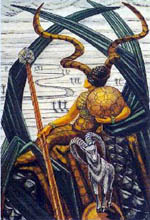
The Queen of DiscsMy pegs are pretty much filled up, though. One could perhaps add “thirteen is ‘dirt queen’”, using, say, an image of the Queen of Discs from Crowley’s Tarot, and “fourteen is ‘floor sheen’”, but I admit my my invention has been failing me on a rhyming peg for “fifteen”.

Extending this further would probably be best done with a different memory system. I did manage to get extra mileage out of some of the pegs by stacking several items into one image (both cellphone and headset for number three, for example, and my Hipster, Moleskine, and a pen for number six). Some of my images (such as the cartoonish St. Peter for number seven) are rather spare, and there’s probably room to hang additional items on the peg.

In general, I am satisfied with the results of this experiment. I would judge this hack to be quite effective at its modest goals, and would further observer that it’s a good introduction to the principles of basic mnemotechnics. I’ll be continuing to use this system for the foreseeable future.

Salaryman hits the pavement

Blurry SalarymanFor the last decade, I’ve worked in the IT department of the same company, a Fortune 500 multinational with well over 100,000 employees. On the whole, the experience has been a positive one. It’s provided stability through difficult times, regular pay, good benefits, and reasonably interesting work

Last week, my department was informed that the company would be “expanding” its “operational excellence” program. On Monday, the suspected meaning of this rather Orwellian phraseology was revealed: I’ll be getting my walking papers. If I’d thought a bit faster, I would have worn a “pink slip” costume on Hallowe’en, despite the risk of an HR incident.

The company has gone through layoffs in the past, but up until now I’ve passed through them unscathed. Each time, those shown the door are assured that it’s nothing personal and does not reflect at all on performance. I’m not sure what effect this is supposed to have on morale, but those who remain seem to find this rather depressing: there’s no safety in personal excellence, and one’s fate lies in the hands of maliciously indifferent accounting trolls.

It was a rough few days coming to grips with this new, less-secure reality, but I’ve adjusted. If they offered me my job back, I wouldn’t take it. I’m taking my decade of real-world experience and my freshly-minted M.S. into a job market that’s looking pretty healthy. There are a few months until my job ends, so there’s plenty of time to find something interesting to do next. I’m even considering switching to working on my Ph.D. full-time for a while, but I suspect that M—— and the cats may not be too keen on living on ramen.

Herr Ziffer’s recent post on technical interviewing would seem to be all too timely . . . time to start sharpening my teeth.

Photo of an Osaka sarariman courtesy JanneM.

Harnessing Wayward Ideas: Setup for MPH #13

My experiences putting Mind Performance Hack #1 into action await a later post, as I am planning to work with each hack for a suitable period of time before drawing conclusions as to its effectiveness or utility. Incidentally, I received a very nice note from Ron Hale-Evans, the primary author of Mind Performance Hacks. Hi, Ron! I hope that this series does not disappoint.

Hack #13, “Catch Your Ideas“, is the first hack of the Information Processing section of the book. Like a fair number of the hacks, it is by an author other than Ron Hale-Evans, in this case, Lion Kimbro. Lion is the author of a curious screed entitled How to Make a Complete Map of Every Thought You Think, a text that does a rather good job delivering what it promises. I scanned through it a few years back and found some definitely interesting bits, but Kimbro says it best himself:

If you do the things described in this book, you will be IMMOBILIZED for the duration of your commitment.The immobilization will come on gradually, but steadily. In the end, you will be incapable of going somewhere without your cache of notes, and will always want a pen and paper w/ you . . . You will not only be immobilized in the arena of action, but you will also be immobilized in the arena of thought. This appears to be contradictory, but it’s not really. When you are writing down your thoughts, you are making them clear to yourself, but when you revise your thoughts, it requires a lot of work- you have to update old ideas to point to new ideas. This discourages a lot of new thinking. There is also a “structural integrity” to your old thoughts that will resist change. You may actively not-think certain things, because it would demand a lot of note keeping work.

Kimbro also describes the positive aspects of his method, but I am far too familiar with (and prone to) system paralysis, the syndrome where some system one is using begins to eat up ever-larger portions of one’s time and life. When I first started keeping journals I was laboriously detailed, attempting to capture every minutia of thought and memory. Such compulsive devotion is only sustainable for limited periods of time.

Hack #13 could be considered HtMaCMoETYT-light, and as such is much more practical than the full system as part of a balanced, mentally healthy lifestyle. It proposes a “catch”, a system to capture and store all those cool ideas that flit through one’s head while one is engaged in hum-drum quotidiana.

It suggests using loose-leaf, ruled 8.5″ x 11″ paper divided into three columns, specifying a broad subject, a “hint” or keyphrase, and the idea itself. One is to always carry such a sheet around and, right after having an interesting thought, one is to capture it in just enough detail so that one can recall it later. These capture sheets are processed regularly, and the ideas copied onto other sheets of paper for each subject and filed. A system for numbering and referencing the ideas is mentioned as well; this seems to be part of Kimbro’s larger system, but its utility as part of this catch system is not immediately apparent to me.

My current system is somewhat related, if not quite as formal. My note-taking apparatus consists of a carefully organized and binder-clipped pack of index cards (a.k.a. a Hipster PDA) and an unruled Moleskine notebook. If I am engaged in an activity where I don’t want anything bulky in my pockets (like taking a lunchtime walk), I’ll stick one or two folded index cards in my pocket and scribble down any ideas that I don’t want to lose.

My Current Catch Idea-Flow

In theory, the scribbles are transferred either to the Hipster (if they are practical actions or goals) or to the Moleskine (if they are interesting ideas that I want to preserve for future contemplation). In practice, though, the scribble-cards often don’t get transcribed in a timely fashion and begin to clutter up my binder clip. The notes in the Moleskine are not organized beyond their chronological capture-dates. Reviewing them can be very interesting, but it’s difficult to assess them in any coherent fashion.

I’ll be modifying this hack as I put it into practice. For the first week I’ll continue to use my current system for capture. Rather than the Moleskine, though, I’ll transfer the notes to larger sheets of paper for each subject (unruled, as I have a prejudice against sloppily-printed blue lines cramping my style).

For the second week, I’ll shift to carrying full sheets of paper around with me (I might even suppress my aesthetics and use ruled, if I have some in the closet) instead of index cards, and compare the experience. For both weeks, I’ll be focusing on paying attention to my ideas as they occur and making notes about them as close to occurrence as possible. I’ve noticed that ideas come in clusters: once I’ve written down one, several more are likely to occur to me in fairly short order.

This hack is strictly paper-oriented: the issues around using computers for idea capture and storage will have to be left as fodder for a later post.

The Waning Garden

Tangled TomatoesEach year, I attempt to grow a garden, and inevitably I engage in overambitious planting. I start off most assiduously, but as the summer progresses the neatly tended, weedless rows degenerate into wild (and often underwatered) tangles. Despite this, the harvest always includes a frightening quantity of tomatoes.
Chard EnvyOur neighbor is a retired Sicilian, and his backyard looks like a small patch of southern Italy. No weeds dare grow in his yard, and his plants are lush and productive. I have chard envy.

Tomatoes and AsparagusHis tomatoes are carefully trained up long poles, trimmed into strict compliance with his will. They tower over my bushy, uncontrolled specimens. In the picture to the right, my tomatoes are lower and in the front, mixed with asparagus fronds. The asparagus is in its second year and has been growing vigorously. I’m looking forward to next spring’s harvest.

Habaneros ready for pickingThe pepper harvest has been quite satisfactory, though I still need to figure out what to do with all these habaneros. The second major crop is ready for harvest.

This year, I managed to keep up with oppressing the weeds and picking the ripe fruit through July, earning approving comments. Inevitably, though, work and school absorbed my attention, and it doesn’t take long for tidiness to transform into a near-jungle.

A Wilderness of FennelTwo years ago I purchased a single purple fennel plant. It grew happily for a season and died among a few green plants that sprang up on their own. Last year, I had quite a few of both the green and purple varieties that grew themselves without any interference on my part, which made me happy. They’re quite attractive and tasty (great for salads, grilled fish, or my favorite coriander-crusted scallops in fennel broth).

This year, the fennel has decided it is in charge. I didn’t fully understand its agenda and let the plants grow as they wished. After they reach a certain height, their stems become woody and more or less impossible to uproot. They are now noticeably taller than I am. If I touch them, fennel seeds rain down on the soil, sealing my fate for next year.

Fennel ResurgentThey smell wonderful in the evenings, though. Arriving home late at night after a long day at work and evening at school, the air is scented with their anise-like aroma.

Despite the late season, a few new fennel plants have started to pop up. The specimen shown at left can be seen menacing my thyme.

Oy, Tarragon!My neighbor may not approve, but an overgrown herb garden is a wonderful thing. My role in tending them is mostly to act as a peacekeeper, setting boundary disputes that arise. I planted a scraggly frond of tarragon two years ago, and it has grown into a monstrous near-bush. I’ve had to tie it back to restrain its depredations against the sage plant that can be seen behind it.

Three SagesPerennial herbs are quite satisfactory, and I’ve had particular luck growing sage, an herb that is both attractive and tasty. Three different kinds can be seen in the picture at left, which I think turned out quite well. (In fact, I’ve cropped a bit of it to use as a header for this site, livening up my depressingly bland template.)

For the moment, the garden’s vigor is subsiding. Soon, I’ll pull out the dying tomato and pepper plants and compost them for use during the next planting. I’ll enjoy the respite from knowing that I really should get around to weeding. Perhaps next year I’ll manage to plant only a reasonable number of tomatoes and to keep everything tended at least through August—but where’s the fun in that?